Skrill vs PayPal in Nigeria: Which is Better for You in 2026?
If you earn money online in Nigeria, whether through freelancing, forex trading, sports betting, or remote work, you’ve almost certainly had to choose between Skrill and PayPal at some point.
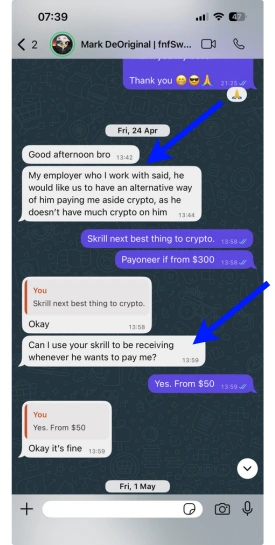
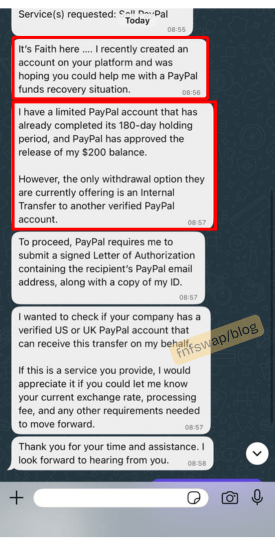
One of our esteemed clients was in this dilemma when he asked how we could help sort – see the screenshot below.
Truth is, both are massive digital wallets used globally. Both will hold your foreign currency until you need Baira.
But for Nigerian users specifically, they work in very different ways, and choosing the wrong one for your situation can cost you real money and days of waiting.
And yeah, if I had to choose between PayPal and Skrill, I believe you know the one I would, right? More on this.
This guide gives you an honest, Nigeria-specific comparison of Skrill and PayPal, covering what each platform does here (not what the global websites promise), their fees, withdrawal options, and which one makes more sense depending on how you earn and my personal preferences.
Table of Contents
ToggleSkrill vs PayPal Popularity in Nigeria
Without having to look at the metrics, I would know that PayPal has more searches because most online shopping websites, e-commerce sites, subscription sites, SaaS, B2B, and more prefer PayPal for so many reasons.
And when you see a Nigerian searching for how to open a PayPal account in Nigeria, it is not that he/she would go that route because of the stress, but because it is a highly in-demand global finance platform.
So, which of them is more popular?
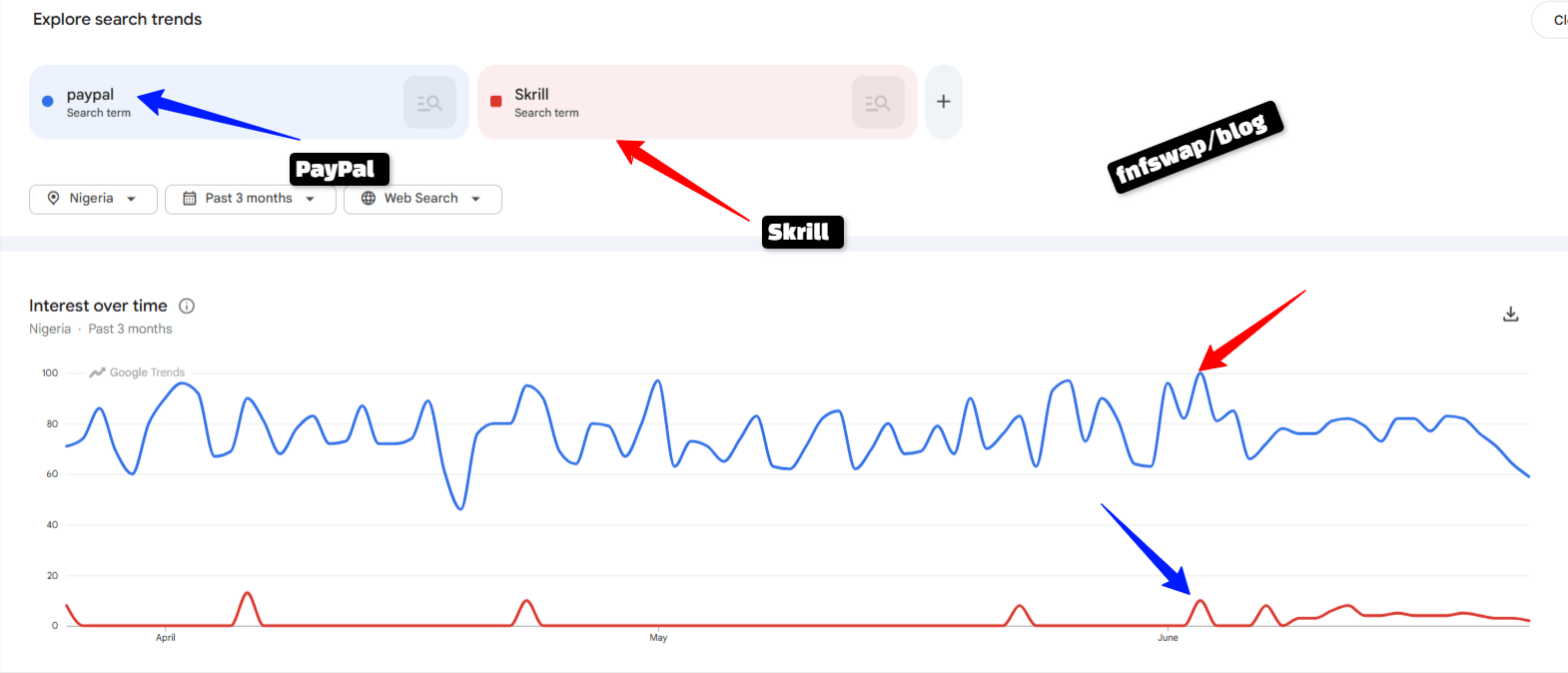
According to Google Trends, in the last week, month, 3 months, and year, PayPal is the most popular platform with an average of 77+ searches a day, as compared to Skrill with 10+.
The Big Picture: How Each Platform Actually Works in Nigeria
Before getting into fees, you need to understand something that generic Skrill vs PayPal comparisons completely miss: these two platforms have very different histories and realities in Nigeria.
PayPal and Nigeria: a complicated 20-year relationship
PayPal restricted Nigerian users from receiving payments as far back as 2004, citing fraud concerns.
For nearly two decades, Nigerian accounts were “send-only”; you could pay for Netflix, Amazon, or Adobe, but you could not receive international income or withdraw to a Nigerian bank.
This was what birthed a niche in the PayPal line; people made money opening a working verified account for digital entrepreneurs in Nigeria, PayPal vendor business, PayPal 180 restrictions lifting gig, and more.
Something happened along the line. Lol.
In January 2026, PayPal announced a partnership with Nigerian fintech Paga, officially allowing Nigerians to receive payments and withdraw in Naira for the first time.
But within hours of the announcement, Nigerian users were already reporting the same familiar problems: accounts getting locked, verification failures, and funds being held.
The underlying infrastructure restrictions that plagued PayPal in Nigeria for 20 years did not disappear overnight.
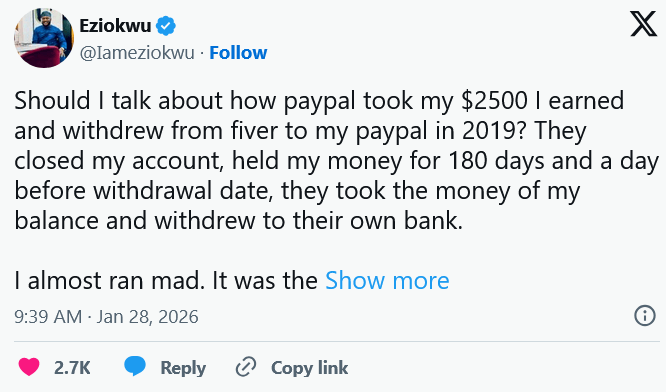
Even the Paga Nigerian account still comes with limitations and is not fully functional, as countries directly approved to use the platform by PayPal.
Skrill and Nigeria: operational but with its own restrictions
Skrill has functioned more consistently in Nigeria for years. It has been a haven for many online hustlers, mostly forex traders, bettors, and for sending money to family abroad.
Nigerians have always been able to open accounts, receive international payments (from employers, forex platforms, betting sites), and hold dollar, euro, or pound balances on Skrill.
The only drawback, which is not a problem, is directly getting that money out into Naira because of blanket restrictions by CBN/Skrill.
And even if you were to use the foreign bank route, Skrill’s own high withdrawal fees and delays [up to 5-7 or more days] in delivery are major cons.
But the silver lining is that, like most Skrillers – no matter your level, you can withdraw Skrill to your Nigerian bank in minutes using the Skrill-to-Skrill method, and with a good exchange rate that maintains your steeze and confidence.
Features Comparison: Skrill vs PayPal in Nigeria
| Feature | Skrill | PayPal |
|---|---|---|
| Can Nigerians open an account? | Yes | Yes |
| Easier verification | Yes | No/complicated |
| Full functionality | Yes – but to about 85% | Yes – but to about 40% |
| Can you receive international payments? | Yes | Personal accounts: No (workarounds needed); Business: limited |
| Direct withdrawal to a Nigerian bank? | Yes, but unreliable due to CBN friction – currently halted | No direct withdrawal |
| Accepted by freelance platforms? | Limited (niche: forex, betting, gaming) – accepted via linked card | Yes, broad (Upwork, Fiverr, Amazon, Adobe, etc.) |
| Accepted by online stores? | Limited via balance – but accepted via linked card | Yes, versatile. Very broad (Amazon, eBay, Netflix, etc.) |
| Cryptocurrency support? | Yes (40+ coins) | Limited |
| Deposit fees | Yes, via card. Free via card to card | Yes, to all methods |
| Inactivity fee? | Yes, ~$5/month after 12 months | No |
| Currency conversion markup | Up to 3.99% | Up to 4.5% |
| Buyer protection/dispute resolution | No | Yes (strong) |
| Account restriction brutality | Severe | High |
| Funds restriction before withdrawal | Days | 6 months |
| Funds withdrawal after restriction | Yes | Yes |
| Most Nigerian friendly | Yes | Moderate |
| Keeping a balance friendly | 90% | 70% |
Fees Compared: Who Charges More?
1. Sending money
- PayPal: Free for domestic transfers funded from a balance or linked bank account. International transfers: up to 5% plus a fixed fee per currency.
- Skrill: 1.45% for Skrill-to-Skrill transfers. Lower than PayPal for international sending in most scenarios.
Winner: Skrill for sending internationally; PayPal for domestic (if applicable).
2. Currency conversion
- PayPal: Applies a markup of up to 4.5% above the mid-market exchange rate.
- Skrill: Applies up to 3.99% above the mid-market rate.
Both platforms earn significantly from FX conversion. At the current mid-market rate of approximately 4.5%, PayPal markup means you receive roughly less on every $1 converted, before any withdrawal fee is counted.
Winner: Skrill – marginally lower FX markup.
3. Withdrawal fees
Skrill:
- Bank transfer: 3.49% + €5.50 flat fee
- Card withdrawal: 7.5%
- Skrill-to-Skrill (exchanger method): 1.45%
PayPal:
- No direct withdrawal to Nigerian banks (for personal accounts).
- Account-to-account fee from Nigeria is up to 2.9% + $0.30 fixed fee.
- Via third-party platforms (Grey, Cleva, fnfSwap): varies by platform
Winner: Skrill, if you use the Skrill-to-Skrill method.
Otherwise, both require workarounds for Nigerians to get naira affordably, and are also influenced by the platform and merchants you are working with.
4. PayPal vs Skrill to Naira
Worked example: receiving $300 and converting to Naira.
Let’s run the numbers on the most common Nigerian use case: you’ve been paid $300 by a foreign client and want Naira in your bank account.
Route A | PayPal (personal account -fnf funfs, via fnfSwap)
| Step | What happens | Cost |
|---|---|---|
| Client pays you $300 on PayPal | PayPal receives it | Free to receive |
| PayPal FX conversion markup on balance | Your $300 is now worth slightly less if converted within PayPal | Up to 4.5% |
| You sell $300 PayPal to fnfSwap | fnfSwap pays naira at the live market rate (~₦1,050/$) | fnfSwap’s rate applies |
| Naira received | Approx. ₦315,000 | ~2 hours |
Note: PayPal workaround (personal account → fnfSwap) bypasses PayPal’s own conversion markup, since you’re selling the dollar balance directly.
The rate can be lower or higher depending on the volume.
Also, fnfSwap receives only fnf PayPal funds balanced, and not gns. If it is GNS, it is better to link a card to the account and withdraw via UBA dollar prepaid card at over ₦1,300/$+
Route B | Skrill (via fnfSwap, Skrill-to-Skrill method)
| Step | What happens | Cost |
|---|---|---|
| Client pays you $300 on Skrill | Skrill receives it | Free to receive |
| Skrill-to-Skrill transfer to fnfSwap | 1.45% fee on $300 = $4.35 | $295.65 sent |
| fnfSwap pays naira at the live rate (~₦1,270/$ or more) | $295.65 × ₦1,270 | ≈ ₦375,000 |
| Naira received | Approx. ₦375,000 | Paid in ~15 mins |
Note: Skrill exchange rate at fnfSwap is influenced by the volume. If the volume is more, you can get more than the exemplified rate above – all at the prevailing market rate.
The clear takeaway: Using Skrill through fnfSwap (exchange method) puts significantly more Naira in your account than using PayPal.
The difference of $300 is over ₦40,000, and with PayPal’s direct withdrawal not even available for personal accounts, the exchanger route is the only viable path for most Nigerians anyway.
Ultimate disclosure: the rates portrayed above are offered on fnfSwap; when you look around, you will likely see lower rates. Maybe, PayPal at ₦900/₦1,000, and Skrill at ₦1,000/₦1,020
PayPal or Skrill, Which Platform is Better for Your Situation?
If you’re a freelancer on Upwork, Fiverr, or Toptal – use PayPal.
As I already earmarked its popularity, PayPal is the dominant platform on all major freelance marketplaces.
If your clients are abroad, they will most likely have PayPal accounts and expect to pay via PayPal.
Even with Nigeria’s receiving limitations, the workarounds (Grey, Cleva, or fnfSwap) are well-established. Skrill is rarely offered as a payment method on these freelance platforms.
If you trade forex or bet on 1xBet, Bet365, or similar platforms, use Skrill
Skrill was built with the forex, steam, and iGaming industry in mind.
Nearly every major forex broker and betting platform that accepts Nigerian users accepts Skrill for deposits and withdrawals.
PayPal, by contrast, has largely withdrawn from gambling and many forex-related transactions due to regulatory policy, making it unreliable or unavailable in these contexts.
If you want to hold cryptocurrency, use Skrill
Skrill supports buying, selling, and holding over 40 cryptocurrencies directly within its wallet.
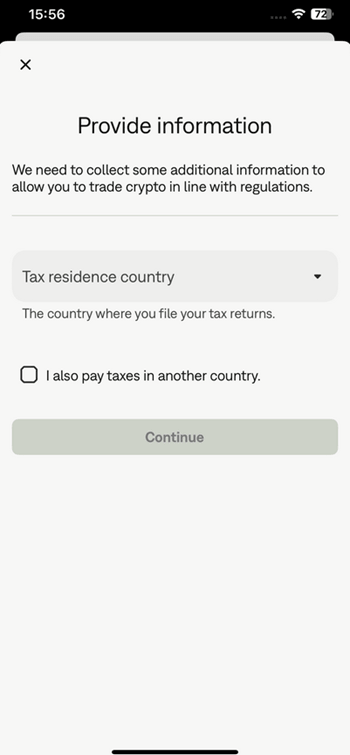
For Nigerians, you will have to go through the Tax documentation to use the crypto feature.
PayPal is not even fully functional in Nigeria, let alone allowing you to use cryptocurrency.
If you need buyer protection for online purchases, use PayPal
PayPal’s dispute resolution and buyer protection are among the strongest in the industry.
How does it work?
If you buy a product online and it doesn’t arrive or isn’t as described, PayPal gives you a formal mechanism to claim your money back.
But Skrill has no equivalent buyer protection for purchases, and payments cannot be reversed by Skrill after complaints.
The most they can do is restrict the account.
If you receive income from a Nigerian employer or local client – neither (use direct bank transfer)
Both Skrill and PayPal are built for international payments. For domestic naira payments, standard Nigerian bank transfers (via your bank app or USSD) are cheaper, faster, and simpler.
If you don’t have either of the accounts, and you want to receive earnings, opt for Skrill
If you don’t have a PayPal or a Skrill account and you want to receive money from a client, you can opt for Skrill. When you do, get in contact with us – to help sort it out.
That is, we will issue an account to use, and send the Naira value to your account
Note: we can only do this from confirmed sources + work and earnings proofs [invoice. No illegitimate businesses are considered. Otherwise, we ignore, and if need be, for escalation, it shall be forwarded to the appropriate authorities.
The CBN PayPal/Skrill Restriction You Need to Understand
Both platforms are affected by CBN regulations, but in different ways:
- PayPal: CBN restrictions historically contributed to PayPal blocking Nigerian receive functionality entirely. Even the 2026 Paga partnership is navigating CBN compliance – which is part of why full withdrawal functionality remains patchy.
- Skrill: Nigerians used to withdraw from Skrill directly to a Nigerian bank account, but the CBN ruled that inbound e-wallet transfers mean many bank accounts are blocked or delayed. This is the main reason Nigerians have shifted to the Skrill-to-Skrill exchanger route – it sidesteps the bank-level CBN restriction entirely.
For both platforms, the practical conclusion is the same: converting through a legit human-faced Nigerian peer-to-peer currency facilitator like fnfSwap is currently the most reliable route to Naira, regardless of whether your funds are in Skrill or PayPal.
Can You Use Both Skrill and PayPal Together?
Yes. And many Nigerian digital workers do exactly this. A common setup:
- PayPal for client-facing work (Upwork, Fiverr, international business clients)
- Skrill for forex or betting platform transactions.
- Both platforms can be sold to fnfSwap independently.
You get a live rate per platform, send funds via the appropriate method (Skrill-to-Skrill for Skrill balance; PayPal fnf transfer via balance or via card – if gns funds), and receive Naira within 15 minutes either way.
Frequently asked questions
Is Skrill or PayPal better for Nigerians?
It depends on your use case. Skrill works better for forex traders, bettors, and anyone needing to hold non-naira balances long-term.
PayPal is better if your clients or platforms prefer it – which is the case for most freelance work.
For converting either to naira, using a registered Nigerian exchanger like fnfSwap beats direct withdrawal on both platforms in both cost and speed.
Can Nigerians receive money on PayPal today?
Personal accounts remain send-only for most Nigerians as of mid-2025.
PayPal announced a partnership with Paga in January 2026 to enable receiving and naira withdrawals, but user reports suggest the rollout has been patchy, with accounts still getting locked and verification issues persisting. Many Nigerians continue to use third-party workarounds to receive PayPal income.
Can I withdraw Skrill directly to my Nigerian bank account?
No. CBN restrictions caused the ban. The Skrill-to-Skrill method (sending to a registered exchanger) is faster, cheaper, and more reliable.
Which platform has lower fees in Nigeria?
Skrill generally has a lower FX conversion markup (up to 3.99% vs PayPal’s up to 4.5%) and lower international transfer fees (1.45% vs PayPal’s up to 5%).
However, the cheapest overall route for both platforms is to sell through fnfSwap, which eliminates the hidden FX markup.
What if my PayPal account gets limited or locked?
PayPal account limitations are a documented and widespread problem for Nigerian users – it was one of the main reasons PayPal lost credibility in Nigeria over 20 years. If your account is limited, PayPal requires identity documents and may hold funds for up to 180 days during a dispute. This is a legitimate risk to factor into your decision, especially if you hold large balances.
Does fnfSwap accept both Skrill and PayPal funds?
Yes. fnfSwap buys both Skrill and PayPal balances and pays naira to your Nigerian bank account within 15 minutes. Contact fnfSwap to get today’s live rate before initiating any transfer.
Sources referenced: PayPal Nigeria account restrictions (Cardtonic, Profee, Spocket – 2025); PayPal-Paga partnership announcement (TechNext24, ICIR – January 2026); Skrill fee schedule (skrill.com/en/siteinformation/fees/); USD/NGN parallel market rate (NairaToday, June 2025).
Need to convert your Skrill or PayPal balance to naira today? Converse with fnfSwap to get started – get a live rate and receive naira in your account in under 15 minutes, including weekends and public holidays.