Pi Coin Price Prediction Analysis 2026 | What Happens Next
Honestly, nobody knows exactly where Pi’s price is going. Anyone telling you they do is selling you something.
You know that popular quote where you become the product? Someone might likely scam you if he or she tells you Pi is going to be $50 in the next 2 weeks.
Notwithstanding, what we can do is look at where Pi is right now, what’s genuinely driving the price up or down, what the different analyst forecasts are saying, and most importantly, what the key catalysts in 2026 could change the picture.
So, whether you’re still holding Pi you mined years ago, thinking about selling some of it, or just trying to figure out if this project is going anywhere, this read is for you.
Where Pi’s Price Stands Right Now (May 2026)
As of late May 2026, Pi was trading at approximately $0.149–$0.152, ranked around #45–55 on CoinMarketCap depending on the day.
The market cap sits at around $1.58 billion, with a circulating supply of roughly 10.59 billion PI out of a total max supply of 100 billion.
That gap between circulating and max supply is one of the most important numbers in this whole story. More on that shortly.
For context on how far Pi has fallen from its peak: the all-time high was $2.98–$2.99, hit back in February 2025, right around the time the Open Network launched.
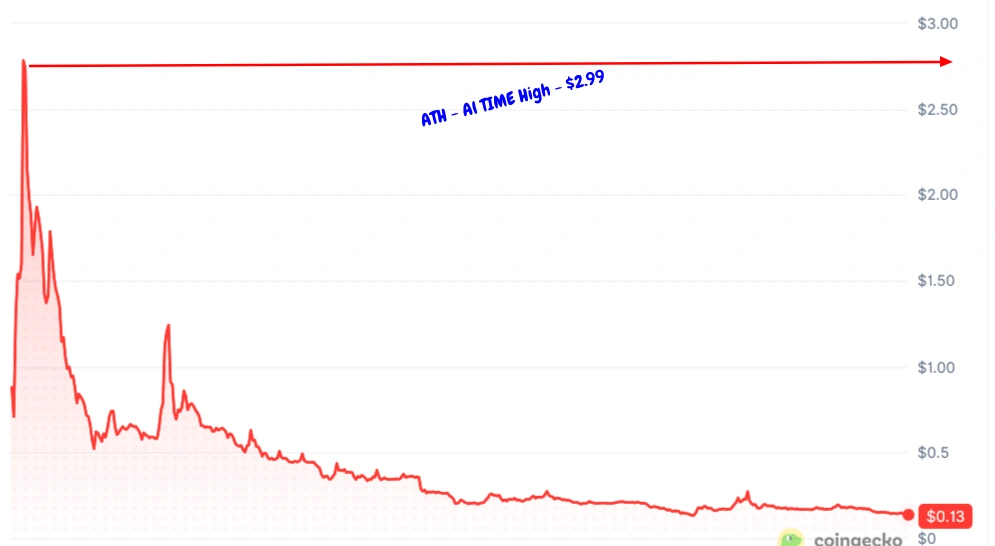
Since then, Pi has been in a prolonged downtrend, sitting roughly 95% below that peak as of today. The all-time low still stands at $0.1312, meaning Pi is hovering uncomfortably close to its floor.
I can’t help but think we might hit another all-time low because they currently hover at $0.14 and $0.15. God have mercy.
Let’s talk about why, and what could change it.
Why Has Pi’s Price Been Falling?
With a lot of questions asked on different Pi communities, here are the suspected real reasons.
1. Token Unlock Pressure – The Biggest Driver
This is the main culprit, and it’s worth understanding clearly.
Pi has a maximum supply of 100 billion tokens. Right now, only about 10.59 billion are in circulation.
As Pioneers complete KYC, migrate their Pi, and unlock their balances, more tokens flow onto exchanges and into the market. That’s increasing.
The numbers are large: the Pi Core Team is expected to unlock more than 200 million PI tokens in a single month, worth roughly $36 million at current prices – Pi scan.
Approximately 1.65 billion PI tokens are projected to enter circulation over the next 12 months.
Just to be specific, probably on May 27, 2026, more than 18 million tokens would have entered circulation in a single day.
If you did economics, you would agree that when supply keeps increasing, and demand doesn’t grow at the same pace, prices drift lower.
2. Exchange Supply at Record Highs
Around mid-May 2026, nearly 540 million PI tokens were sitting on approved centralized exchanges, the largest exchange-held supply since Pi’s mainnet launch.
High exchange balances typically signal that holders are positioning to sell, not hold. Thin liquidity on Pi’s trading pairs means even moderate sell waves can push the price down harder than they would on a more established coin.
3. Not Yet on Binance or Coinbase
Pi is currently listed on platforms such as OKX, Bitget, Kraken, etc. However, the two biggest exchanges, Binance and Coinbase, have not listed PI. That’s a significant gap.
A Binance or Coinbase listing alone would expose Pi to tens of millions of additional potential buyers and dramatically improve liquidity. Until that happens, Pi’s order books remain shallow.
4. Broader Crypto Market Weakness
Pi doesn’t exist in a vacuum. When Bitcoin pulled back toward $77,000 earlier in 2026, with Ethereum dropping and rising bond yields pushing investors away from risk assets, Pi felt it too.
So, it is safe to say that altcoins get hit harder than Bitcoin in market retreats, and Pi is no exception.
5. The Hype-Utility Gap
Just as some who want to use Pi for car purchases, Millions of Pioneers have been waiting for years for Pi to have real-world utility.
The project is now delivering on that technically, but the market tends to price in expectations ahead of time. When those expectations aren’t met instantly, sentiment sours.
Trith is, Pi’s price reflects a project that’s technically progressing but hasn’t yet converted its massive user base into active economic participants.
6. Pi Events and Special Day
It is observed and known that the Pi price surges when there is a popular Pi event or special day.
For instance, the last Pi Day in March saw Pi rising to $0.29 from $0.13.
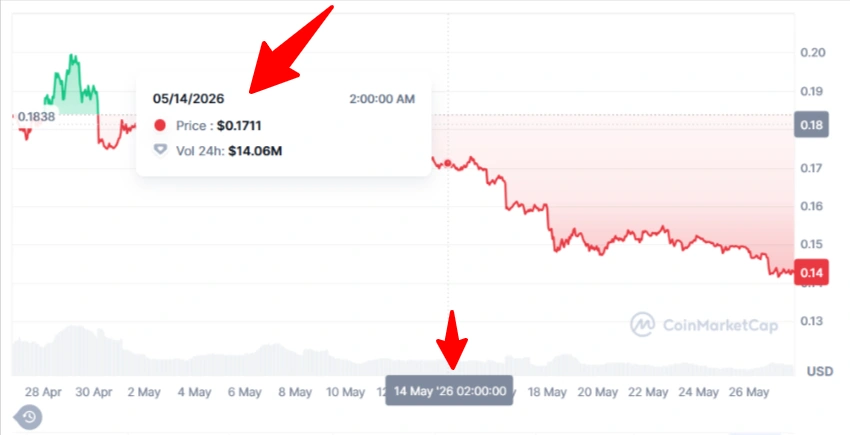
It is plain annoying that Pi does not move based on solid factors but is situational. This is not right.
What’s Actually Happening on the Development Side – the Pros
Here’s where it gets more interesting. Beneath the disappointing price chart, the Pi Network has been moving faster on infrastructure in 2026 than at any previous point in its history.
1. Protocol v23 – The Biggest Technical Upgrade Ever
On May 18, 2026, Pi activated Protocol v23 – described as the most consequential technical event in Pi Network’s history. This upgrade transitioned the network to Stellar Core v23.0.1, enabling:
- Full smart contract support on Mainnet -Pi went from a payment token to a programmable blockchain
- Native on-chain DEX – a decentralized exchange built directly into the Pi ecosystem, allowing Pi holders to trade tokens peer-to-peer without going through a centralized platform
- DApp support – different developers can now build and deploy decentralized applications directly on Pi’s blockchain
In summary, Pi spent five years building one of crypto’s largest user bases through mobile mining. Protocol v23 gave that community something it never had before: a programmable, functional blockchain.
2. Pi Launchpad
Pi reported over 480,000 users joining its Launchpad ecosystem – a platform designed to connect developers with Pi’s verified user base.
That structure is unusual and, if it takes hold, could create real demand-side pressure for PI tokens over time. Why?
Because it requires a working application before any token launch and directs proceeds to liquidity pools rather than project wallets.
3. 18.1 Million KYC-Verified Users
Pi’s April 2026 ecosystem update confirmed the network surpassed 18.1 million fully KYC-verified users and over 16.72 million mainnet migrations.
For context, most blockchain projects dream of user numbers like these.
Whether that user base converts into active economic participants is the central question for Pi’s price in 2026 and beyond.
4. Consensus 2026 Appearance
Co-founder Dr. Chengdiao Fan appeared at the major Consensus 2026 conference in May, making the case for Pi as “human infrastructure for AI” – leaning into the network’s unique identity verification layer (over 526 million verification tasks completed).
Whether or not that narrative catches on with institutional eyes remains to be seen, but the point is that it signals the team is actively trying to reframe Pi’s value proposition beyond just being a mining app.
Read Also:
What the Analysts Are Forecasting for 2026
Price predictions for Pi vary wildly, more than almost any other crypto you’ll find.
This is partly because Pi’s situation is genuinely unusual: enormous user base, real infrastructure development, but also massive supply overhang and limited exchange access.
Here’s what different sources are saying.
1. The Conservative End
Several technical analysis platforms see Pi trading in the $0.12–$0.20 range for most of 2026, with oversold conditions potentially supporting a modest bounce but continued token unlock pressure capping upside.
- CoinDCX notes Pi is currently below key exponential moving averages with RSI around 28.5. Meaning, it is technically oversold but not yet showing reversal signals.
- CoinDataFlow’s forecast has Pi averaging around $0.08–$0.186 for 2026.
These models essentially see Pi grinding sideways or slightly lower until a real demand catalyst arrives.
2. The Moderate Scenario
- io’s model estimates an average of around $0.21 for 2026, with a potential trading band between roughly $0.16 and $0.27.
This scenario assumes steady ecosystem development but no major breakout event.
- CoinLore’s projection places PI’s year-end 2026 price around $0.69 in a more optimistic moderate case, with a minimum of $0.12.
This range – somewhere between $0.20 and $0.70 by year’s end – represents the middle-of-the-road view: token unlock pressure persists, but Protocol v23 and DEX utility start to attract some real demand in the back half of the year.
3. The Optimistic Scenario
Coinpedia’s forecast is considerably more bullish, putting Pi’s 2026 target at an average of $0.85–$2.25 if mainnet development progresses, major exchanges come on board, and the ecosystem’s 18+ million verified users start actively transacting.
The upper bound of $3.50 would require Pi to challenge its all-time high.
This scenario requires a few things to go right simultaneously: a Binance or Coinbase listing, the Pi DEX generating real trading volume, and broader crypto market conditions improving.
4. The “Moonshot” Calls
Some prediction models throw out ambitious numbers like $22 by 2030 or even wilder figures.
While it looks exciting, the fact is, these are mostly algorithmic models fed on historical volatility, not genuine analysis.
Therefore, you want to treat them accordingly, with discretion and disclaimers.
The Key Catalysts to Watch for Pi Price Rise
Based on what’s currently in motion, these are the developments most likely to move Pi’s price meaningfully in either direction.
1. Binance Listing (Wildcard Bullish)
No confirmed date. But if Pi gets listed on Binance, which alone commands roughly 40% of global crypto spot volume, it would be the single biggest price event in Pi’s history.
2. Pi DEX Gaining Real Volume (Bullish)
The DEX launched with Protocol v23 on May 18. If it attracts genuine trading activity, it creates direct utility demand for PI tokens, and people need PI to use the DEX.
Early volume data from the DEX will be one of the most-watched metrics for the price surge.
3. Token Unlock Schedule (Ongoing Bearish Pressure)
About 1.65 billion tokens entering circulation over the next 12 months is a structural headwind. Not encouraging for the market price movements.
Unless demand grows to absorb that supply, then consistent pressure on price is the likely result.
You can follow up on the month-by-month unlock data on Pi scan.
4. Smart Contract Adoption (Medium-Term Bullish)
Pi’s smart contract capability is new because developer adoption takes time.
However, if meaningful DeFi applications or payment systems are built on Pi, that changes the demand picture materially.
5. Broader Crypto Market
Bitcoin’s price trajectory matters for every altcoin. If BTC continues recovering and enters another bull phase, it is expected that altcoins will do the same.
What the Pi Community Is Actually Saying
Based on popular Pi communities, here are the sentiments.
On one side: long-time Pioneers who are frustrated, pointing out that the price has been falling for over a year despite real development progress, and questioning whether token unlock pressure will ever be solved.
On the other: an equally large camp that’s been accumulating (or simply holding) and pointing to Protocol v23, the DEX, and the potential Binance listing as reasons why now is a time to be patient.
Both camps have legitimate points. The honest answer is that Pi is at an inflection point: the technical foundation is now stronger than it’s ever been, but supply dynamics remain a genuine headwind that will take real demand, not just development milestones, to overcome.
What of GCV Pi Price of $314,000+?
The symbolic Global Consensus Value (GCV) proposed by parts of the Pi Network community is $314,159 per Pi.
This was framed by enthusiastic Pi holders and has never been officially endorsed by the Pi Core Team. In summary, it is nonsense. Forget about it.
So, Should You Hold, Sell, or Wait?
People often ask me this. The thing is that everybody’s situation is different.
How much Pi you have, what your cost basis is (zero, since you mined it), and what you need the money for, there’s no universal right answer.
What is worth thinking about:
- If you mined Pi for free, any price is technically a profit. The question is opportunity cost and timing, not loss prevention.
- If you’re planning to hold long-term, Protocol v23, the DEX, and the potential Binance listing are genuine reasons for patience. But the 1.65 billion tokens unlocking over the next year are also a real reason for measured expectations.
- If you want to convert some Pi to cash now, that’s a legitimate choice, especially if you need liquidity. And that’s exactly what fnfSwap Freelance is for.